The Invention Idea Checklist: 10 Questions to Answer Before You Pay Anyone
Jun 17, 2026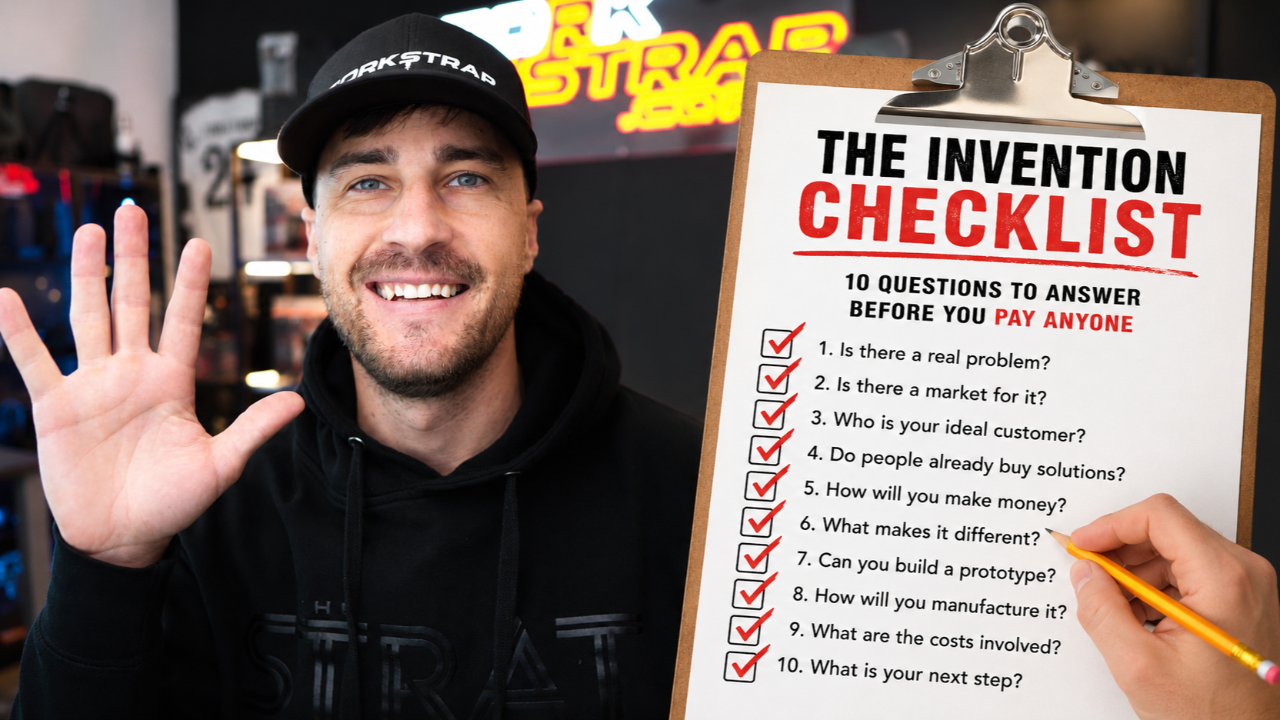
The Invention Idea Checklist: 10 Questions to Answer Before You Pay Anyone
Before you pay anyone for your invention idea, answer one hard question first: do you have evidence that this idea solves a real problem for a real buyer?
That evidence matters more than excitement, compliments, sketches, patents, or polished presentations. Many inventors lose money because they pay too early for services they do not need yet: market research reports, virtual prototypes, engineering packages, patent work, licensing submissions, branding, manufacturing help, or invention promotion services.
This invention idea checklist is designed to slow you down in the right way. Not to kill your idea. Not to make you overthink forever. But to help you decide what proof you need before spending serious money.
Not sure if your product idea is worth pursuing? Start with the Free Inventor Validator from Invent With Me before you pay anyone for the next step.
What Should You Check Before Paying Anyone for an Invention Idea?
Before paying for invention services, answer these 10 questions:
|
# |
Checklist Question |
Why It Matters |
|
1 |
What exact problem does your invention solve? |
No real problem means weak demand. |
|
2 |
Who is the specific buyer? |
Products are bought by specific people, not vague audiences. |
|
3 |
How painful or urgent is the problem? |
Stronger pain creates stronger buying motivation. |
|
4 |
What are people using now instead? |
Every invention competes with something. |
|
5 |
Why is your invention meaningfully better? |
“New” is not enough. It must be better in a way buyers care about. |
|
6 |
Can you explain the product in one sentence? |
If people cannot understand it quickly, they will not buy quickly. |
|
7 |
Has anyone outside friends and family shown real interest? |
Polite encouragement is not market validation. |
|
8 |
Can you test the idea cheaply before building the perfect version? |
Early testing protects you from expensive mistakes. |
|
9 |
What would it cost to make and sell? |
A product must make financial sense, not just technical sense. |
|
10 |
What proof do you need before paying for the next step? |
Spending should follow evidence, not hope. |
Invention idea validation means checking whether your idea solves a real problem, has a clear buyer, can be explained simply, can be made affordably, and has enough demand to justify the next investment.
For more real-world inventor education, listen to the Invent With Me Podcast, where Grant Martin and guests discuss validation, prototyping, manufacturing, patents, marketing, retail, and product-business building.
Why You Should Pause Before Paying Anyone for Your Invention Idea
When you first have an invention idea, the natural instinct is to protect it, build it, and show it to someone who can “make it happen.”
That instinct is understandable.
It is also where many inventors make their first expensive mistake.
The first step is not always a patent. It is not always a prototype. It is not always hiring a product design firm. It is not always paying an invention promotion company. And it is definitely not paying someone simply because they tell you your idea is great.
The first step is clarity.
You need to know:
- What problem the product solves
- Who would buy it
- Whether the problem is painful enough
- What people use now
- Whether your solution is meaningfully better
- Whether you can test demand cheaply
- Whether the numbers can work
- What proof you need before paying for the next step
This matters because some high-fee invention promotion firms sell hope before evidence. The Federal Trade Commission’s invention marketing scams guidance warns that dishonest invention marketers may exaggerate profit potential to get inventors to pay for expensive, often low-value services.
Use this checklist before paying for:
- Patent help
- Prototype development
- CAD or engineering work
- Product validation reports
- Market research
- Licensing submissions
- Manufacturing support
- Branding or packaging
- Invention promotion services
- Business coaching or consulting
That does not mean those services are always bad. Some services can be useful at the right time. The key is sequence. You should know what you are paying for, why you need it, and what evidence supports that decision.
The 10-Question Invention Idea Checklist
1. What exact problem does your invention solve?
Start with the problem, not the product.
Weak invention thinking starts like this:
“I have a new kind of tool.”
Stronger invention thinking starts like this:
“People struggle to do this task quickly, safely, or affordably, and current products do not solve the problem well.”
Your invention does not need to solve a world-changing problem. But it does need to solve a problem that buyers recognize. If the problem is unclear, the product will be difficult to explain, difficult to market, and difficult to sell.
Ask yourself:
- What frustrating situation creates the need for this product?
- Who experiences that situation?
- How often does it happen?
- What does the problem cost them in time, money, effort, safety, or convenience?
- What happens if they do nothing?
A good product idea usually starts with a real-world irritation. A better product idea starts with an irritation people are already trying to solve.
If you are unsure whether your idea solves a clear enough problem, use the Free Inventor Validator before spending money on patents, prototypes, or market research.
2. Who is the specific buyer?
A common inventor mistake is saying, “Everyone could use this.”
That usually means the buyer is not clear enough.
A strong invention idea has a specific buyer. Sometimes the user and buyer are the same person. Sometimes they are different.
|
Product Type |
User |
Buyer |
|
Children’s product |
Child |
Parent or caregiver |
|
Pet product |
Pet |
Pet owner |
|
Jobsite tool |
Worker |
Contractor, business owner, or purchasing manager |
|
Outdoor product |
Camper, kayaker, truck owner, homeowner |
Often the same person |
|
Senior-care product |
Older adult |
Adult child, caregiver, facility, or user |
|
Kitchen product |
Home cook |
Home cook or household buyer |
You need to know who makes the purchase decision. That person determines your marketing message, price point, sales channel, packaging, and proof.
Ask:
- Who has the problem?
- Who pays to solve it?
- Where does that buyer already shop?
- What words would they use to search for a solution?
- What would make them trust a new product?
If you cannot describe the buyer clearly, do not pay for expensive services yet. Start with buyer research.
For real inventor examples and product-development conversations, explore the Invent With Me Podcast.
3. How painful or urgent is the problem?
Not all problems are equal.
Some problems are mild annoyances. Others waste time, create risk, cost money, or happen repeatedly. The more painful and frequent the problem, the easier it is to justify a purchase.
Use this scoring table:
|
Score |
Problem Strength |
What It Means |
|
1 |
Mild annoyance |
Hard to sell unless the product is very cheap or entertaining |
|
2 |
Occasional frustration |
Needs strong differentiation |
|
3 |
Repeated inconvenience |
Worth testing with potential buyers |
|
4 |
Costly, time-wasting, or stressful problem |
Strong commercial potential |
|
5 |
Safety, money, health, or urgent-use problem |
Strongest buyer motivation |
A product does not have to be urgent to succeed. But if the problem is weak, your product needs another strong advantage: lower price, better design, convenience, novelty, emotional appeal, or a large audience.
Be honest here. Many inventors overestimate the problem because they personally care about the idea. The market may not feel the same urgency.
4. What are people using now instead?
Every invention competes with something.
Even if there is no identical product, people are still solving the problem somehow. They may be using:
- A competing product
- A DIY workaround
- A cheaper substitute
- A manual process
- A professional service
- A habit
- Another product used in the wrong way
- Nothing at all
“Nothing” is still a competition because doing nothing costs zero dollars.
This is where invention market research becomes practical. Do not start by paying for a big report. Start by looking at what buyers already do.
Check:
- Amazon reviews
- YouTube comments
- Reddit discussions
- Facebook groups
- Niche forums
- Retail product reviews
- Competitor websites
- TikTok/Instagram product demos
- Trade show exhibitor lists
- Google search results
Look for repeated complaints. Complaints are often more valuable than compliments because they reveal gaps.
|
What Buyers Say |
What It May Reveal |
|
“This breaks too easily.” |
Durability gap |
|
“It is too hard to use.” |
Usability gap |
|
“It is too expensive.” |
Price gap |
|
“It does not fit my situation.” |
Niche-use gap |
|
“I wish it had…” |
Feature opportunity |
|
“I tried three of these and none worked.” |
Strong pain point |
If your invention solves a complaint that appears again and again, you may have a stronger idea.
5. Why is your invention meaningfully better?
Different is not enough. New is not enough. Clever is not enough.
Your invention must be better in a way the buyer actually values.
Possible advantages include:
|
Advantage |
Strong or Weak? |
|
Cheaper |
Strong if quality stays acceptable |
|
Faster |
Strong if speed matters to the buyer |
|
Safer |
Strong if the risk is real |
|
Easier to use |
Strong if current products are frustrating |
|
More durable |
Strong if current products break often |
|
Smaller or lighter |
Strong for travel, tools, outdoor, or storage products |
|
Better looking |
Strong in lifestyle, home, fashion, or giftable categories |
|
More convenient |
Strong if it removes steps |
|
“No one has seen this before” |
Weak by itself |
A buyer does not care that you invented something. They care that your product gives them a better outcome.
Write your advantage in this format:
Compared with [current option], this invention is better because [specific buyer benefit].
Example:
Compared with regular tie-down straps, this product is better because it helps maintain tension more consistently during transport.
That is clearer than saying:
“It is a revolutionary new strap.”
Avoid hype. Be specific.
If you want feedback from other inventors, entrepreneurs, and product builders, consider joining the Invent With Me community.
6. Can you explain the product in one sentence?

If you cannot explain your invention simply, the market will struggle to understand it.
Use this formula:
This product helps [specific buyer] solve [specific problem] by [clear mechanism or benefit].
Examples:
This product helps truck owners secure cargo faster by keeping strap tension more consistent during transport.
This product helps parents organize small toys by turning cleanup into a simple sorting system.
This product helps kayakers load gear more easily by reducing the number of loose straps they need to manage.
Your one-sentence explanation should be clear enough for a stranger to understand without a long demonstration.
If you need five minutes to explain the idea, you may have one of three problems:
- The product is too complex.
- The buyer is not clear.
- The benefit is not strong enough.
That does not mean the idea is bad. It means the message needs work before you pay for marketing, branding, or sales materials.
7. Has anyone outside friends and family shown real interest?
Friends and family can be supportive, but they are not enough to validate an invention idea.
They may tell you it is great because they care about you. They may not want to discourage you. They may not represent the real buyer. They may not understand the market. Most importantly, they may never actually buy the product.
Stronger signs of validation include:
- A stranger asks what it costs
- Someone joins a waitlist
- Someone signs up for updates
- Someone asks when it will be available
- Someone shares the idea with another potential buyer
- A niche group responds positively
- A retailer or business owner asks follow-up questions
- Someone pays a deposit
- Someone preorders
- Someone agrees to test a rough prototype
The best early validation is not praise. It is behavior.
Ask:
- Did people ask to buy?
- Did they ask the price?
- Did they sign up?
- Did they share it?
- Did they compare it to something they already use?
- Did they explain the problem back to you in their own words?
If the answer is no, do not panic. It just means you need more testing before bigger spending.
8. Can you test the idea cheaply before building the perfect version?
Your first test should not be the most expensive version of the product.
Many inventors want to jump straight to a polished prototype, final CAD model, advanced engineering package, or manufacturing-ready sample. Sometimes that is necessary later. But early on, your goal is to learn quickly and cheaply.
The USPTO’s youth invention guidance explains that prototypes do not have to be life-size or made from final materials, and that testing, evaluating, redesigning, and iterating are core parts of the invention process.
Cheap testing options include:
|
Test |
Cost Level |
What It Proves |
|
Sketch + buyer interviews |
Low |
Whether people understand the problem |
|
Competitor review research |
Low |
Whether current products have gaps |
|
Simple landing page |
Low |
Whether people click or sign up |
|
Demo video |
Low to medium |
Whether people understand the benefit |
|
Rough prototype |
Low to medium |
Whether the concept can work |
|
3D print or handmade model |
Medium |
Whether the form/function makes sense |
|
Small sample batch |
Medium |
Whether people may buy or use it |
The goal is not to look perfect. The goal is to reduce uncertainty.
Before paying for a polished prototype, ask:
- What is the cheapest way to test the core function?
- What question do I need this prototype to answer?
- Am I testing demand, function, cost, or usability?
- Could a rough version answer the same question?
For more practical episodes on prototyping, sampling, manufacturing, 3D printing, and product development, browse the Invent With Me Podcast episodes.
9. What would it cost to make and sell?
A product can be useful and still fail as a business.
Before you pay for manufacturing or branding, you need a basic understanding of unit economics. You do not need perfect numbers yet, but you need realistic assumptions.
Think through:
|
Cost Area |
Question to Ask |
|
Product cost |
What might one unit cost to make? |
|
Tooling or molds |
Will there be expensive setup costs? |
|
Packaging |
Does the product need custom packaging? |
|
Shipping |
Is it heavy, fragile, oversized, or costly to ship? |
|
Storage |
Will inventory take up space or require special handling? |
|
Returns |
Is the product likely to be returned if expectations are unclear? |
|
Platform fees |
Will you sell on Amazon, Shopify, retail, or wholesale? |
|
Marketing |
How will buyers discover it? |
|
Retail margin |
Can the product survive wholesale pricing? |
|
Profit per unit |
Is there enough margin after all costs? |
A simple version:
If it costs $12 to make and ship to your warehouse, and you sell it for $29.99, do you still have enough margin after packaging, shipping, platform fees, returns, advertising, and overhead?
If the numbers do not work, you may need to change the design, target buyer, sales channel, price, or manufacturing approach.
This is one reason Invent With Me focuses on building real product businesses, not just chasing invention excitement. A product must work in the real world and on a spreadsheet.
Inventors who need more structured support can learn through monthly inventor webinars, where the community discusses product development, sourcing, patents, marketing, and sales.
10. What proof do you need before paying for the next step?
This is the most important question.
Do not ask, “What should I buy next?” Ask:
“What proof do I need before the next expense makes sense?”
Use this decision table:
|
Situation |
Smart Next Step |
|
The idea is unclear |
Write a one-sentence product statement |
|
The buyer is unclear |
Interview potential buyers |
|
The problem seems weak |
Research stronger use cases or customer pain points |
|
Competitors already exist |
Study reviews, complaints, and market gaps |
|
People understand the idea but do not want it |
Rework the offer, buyer, or problem |
|
People show interest |
Build a rough test, landing page, or simple prototype |
|
The prototype works |
Test price, demand, and usability |
|
Demand is proven |
Consider patent guidance, sourcing, manufacturing, or consulting |
|
You feel pressured to pay a firm quickly |
Pause, verify claims, and ask for written disclosures |
Spending should be tied to evidence.
That is the difference between building a product business and buying hope.
The USPTO patent process overview begins with deciding whether a patent is right for you, understanding fees, and searching for similar inventions. That sequence matters. Patent work can be important, but it should fit the strategy instead of replacing market proof.
Before You Pay, Ask These Questions First
Use this table before paying for any invention-related service:
|
If You Are About to Pay For… |
Ask This First |
|
Patent help |
Have I checked whether a patent is the right next step? |
|
Prototype design |
Do I know the minimum version needed to test the idea? |
|
CAD or engineering |
Am I solving a technical problem or just trying to look polished? |
|
Market research |
Can I gather direct buyer evidence first? |
|
Invention promotion |
What written disclosures and outcomes can the firm provide? |
|
Licensing help |
Do I understand how licensing actually works? |
|
Manufacturing |
Do I know target cost, MOQ, quality requirements, and sales channel? |
|
Branding |
Do I know who the buyer is and why they care? |
|
Advertising |
Have I proven the message converts organically or cheaply first? |
|
Consulting |
Do I know what decision I need help making? |
The right service at the wrong time can still waste money.
If you need direct strategic help deciding what should come next, Invent With Me offers consulting with Grant, including private monthly consulting sessions, webinars, and community access.
Green Light, Yellow Light, or Red Light: What Your Answers Mean
After answering the checklist, sort your idea into one of three categories.
|
Signal |
What It Means |
Recommended Action |
|
Green light |
The problem is clear, buyer is specific, people show real interest, and rough numbers may work |
Move to the next validation step, prototype test, or business planning |
|
Yellow light |
The idea is interesting, but buyer, demand, cost, or message is unclear |
Keep testing before spending heavily |
|
Red light |
No clear buyer, weak problem, expensive production, no outside interest, or pressure to pay quickly |
Pause and rethink before buying services |
A red light does not always mean the idea is dead. It means the current version is not ready for serious investment.
A yellow light is common. Most invention ideas need refinement.
A green light does not mean guaranteed success. It means you have enough evidence to justify the next smart step.
Be Careful With Companies That Want Money Before You Have Proof

There are legitimate inventions, patents, designs, engineering, manufacturing, and marketing professionals. Inventors sometimes need expert help.
But be careful with high-fee invention promotion firms or low-transparency services that show enthusiasm before evidence.
The FTC’s invention marketing scams resource warns that dishonest marketers may claim there is a proven market for an invention without real proof, charge thousands of dollars in fees, make success sound guaranteed, or claim access to manufacturers before the inventor pays.
Red flags include:
- They say your idea has huge potential before doing real analysis.
- They pressure you to act quickly.
- They charge large upfront fees before clear deliverables.
- They make licensing sound easy or likely.
- They ask for a cut of future profits while also charging heavy service fees.
- They sell generic market research or virtual prototypes as proof.
- They avoid clear written success-rate disclosures.
- They focus more on selling services than testing the market.
- They make you feel foolish for asking questions.
Before paying, ask:
- How many inventions has the firm evaluated?
- How many received positive vs. negative evaluations?
- How many clients made more money than they paid the firm?
- How many clients received licensing agreements?
- What exactly will I receive?
- Is the work custom or template-based?
- Who owns the work product?
- What results are guaranteed?
- Can I review the full agreement before paying?
- Can I speak to real past clients?
The FTC states that federal law gives inventors the right to get information about an invention marketing firm’s operations and clients before signing a contract. The FTC also recommends checking complaints, references, online reviews, and getting promises in writing before signing.
The USPTO scam prevention page also advises inventors to check the reputation of invention promoters and be wary of firms that promise too much or cost too much. The USPTO maintains a public page for invention promoter and promotion firm complaints, which inventors can review as part of due diligence.
Do not confuse flattery with validation. If a company tells every inventor their idea is promising, that is not expertise. That is a sales process.
Use legally careful thinking. The question is not, “Is every invention company bad?” The better question is:
“Does this company provide clear, verifiable value before asking me for serious money?”
If not, pause.
What to Do Next If Your Idea Passes the Checklist
If your invention idea survives the checklist, do not rush into the most expensive next step. Move one level forward.
Here is a practical path:
- Take the Free Inventor Validator.
- Write your one-sentence product statement.
- Identify your buyer.
- Study current alternatives and reviews.
- Talk to potential buyers.
- Build the cheapest useful test.
- Validate price and demand.
- Improve the concept.
- Learn whether patent, prototype, manufacturing, or marketing support makes sense.
- Join a community of inventors and product builders so you are not making decisions alone.
You can also explore the Invent With Me Podcast for real conversations about validation, prototyping, manufacturing, patents, retail, marketing, trade shows, and product-business building.
If you want feedback from other inventors and product builders, join the Invent With Me community. If your idea is ready for deeper strategy, consider monthly webinars or consulting with Grant.
FAQs
What should I do first if I have an invention idea?
- The first step is to define the problem, buyer, current alternatives, and simplest way to test demand. Do not start by paying for the most expensive service. Start by proving that the idea solves a real problem for a specific buyer. A practical place to start is the Free Inventor Validator.
Should I patent my invention before validating it?
- Not always. Patent strategy can matter, but many inventors spend too early before proving demand. A smarter path is to understand the buyer, market, problem, and feasibility first, then speak with a qualified patent professional when protection becomes a clear strategic need. The USPTO patent process overview is a useful place to understand the basic patent path.
How do I know if my invention idea is worth pursuing?
- Look for evidence. A strong invention idea usually has a clear problem, a specific buyer, repeated pain, weak current alternatives, a simple explanation, real interest from people outside friends and family, and a realistic path to profit.
Is feedback from friends and family useful?
- It can be useful for encouragement, but it is not enough for validation. Friends and family may be polite. Real validation comes from potential buyers, niche communities, waitlists, preorders, prototype testers, or people who ask serious purchase-related questions.
What is the cheapest way to test an invention idea?
- Start with buyer interviews, competitor review research, sketches, a simple landing page, a demo video, or a rough prototype. You are trying to answer one question at a time, not build the final product immediately. The USPTO’s invention activity guidance also emphasizes testing, evaluating, redesigning, and iteration.
Are invention promotion companies always bad?
- No. The point is not that every service is bad. The point is that inventors should verify claims, understand fees, ask for written disclosures, and avoid pressure before paying. A reputable service should be clear about what it does, what it does not guarantee, and what evidence supports the next step.
What should I ask before paying an invention company?
- Ask how many customers made net profit, how many received licensing agreements, what the full cost will be, what deliverables are included, whether the work is custom, who owns the work, and what happens if the project fails. The FTC invention marketing scams guide explains several questions and checks inventors should make before signing.
What is the next step after using this invention idea checklist?
- If the idea looks promising, take the Free Inventor Validator, gather real buyer feedback, and decide whether the next step is a rough prototype, patent guidance, manufacturing research, marketing test, community feedback, or consulting.
Conclusion
Inventors do not need more hype. They need a clear path.
Before you pay anyone, answer the 10 questions in this checklist. Know the problem. Know the buyer. Know the alternatives. Know why your solution is better. Test cheaply. Watch for red flags. Spend money only when the evidence supports the next step.
The goal is not to protect an idea forever. The goal is to build something people understand, want, and may actually buy.
Before spending serious money on patents, prototypes, market research, or invention services, take the Free Inventor Validator from Invent With Me and get a clearer read on whether your idea is ready for the next step.